

News Updates
Improve engineering technology, develop the environmental protection industry, enhance economic benefits, and promote Earth's regeneration.
19
2025
-
09
Introduction to the Oxygen Index Combustion Test Method
Author:
The Limiting Oxygen Index method refers to measuring the lowest oxygen concentration—expressed as the volume percentage of oxygen—in a mixed gas of O₂ and N₂—that can just sustain the combustion of a polymer sample. It serves as an index characterizing the material's burning behavior.
It is generally accepted that materials with an oxygen index below 22% are classified as flammable, those between 22% and 27% are considered combustible, and materials with an oxygen index exceeding 27% are categorized as difficult-to-ignite. Therefore, samples deemed to have flame-retardant properties must have a limiting oxygen index of at least 28%.
There are several standards for testing the limiting oxygen index, including GB/T 5454-1997, GB/T 2406.2-2009, and ISO 4589.2-2016. Since GB/T 2406.2-2009 and ISO 4589.2-2016 are typically used for oxygen index testing of plastic products, domestically, the standard GB/T 5455-1997 "Textile Materials—Determination of Burning Behavior—Oxygen Index" is generally preferred for testing textiles. The main steps involved in the oxygen index method are as follows:
- Cut 15 samples, each measuring 58mm × 150mm, from the warp and weft directions of the fabric. Then, condition these samples under constant temperature and humidity—specifically at 20°C and 60% RH—for 24 hours. (This conditioning process ensures that each sample reaches a uniform temperature and moisture level, minimizing errors caused by variations in fabric temperature and humidity, thus enhancing the accuracy of the test results.) Finally, securely clamp the samples into the testing fixtures.
- Once the sample is securely fixed, place the combustion cylinder over it and adjust the oxygen proportion setting on the instrument interface. (For samples whose oxygen index values are unclear, a partial combustion test in air can be conducted to help determine the appropriate starting point: If the sample ignites quickly and burns vigorously in air, begin with an oxygen concentration of 18%; if the sample burns slowly or exhibits unstable combustion in air, start at 21%; and if the sample fails to ignite at all in air, proceed with an oxygen concentration of 25%. Note that the higher the set value, the stricter the flame-retardant requirements for the sample.) After adjusting the gas flow rate, purge the system with the specified gas mixture for 0.5 to 1 minute (ensuring that the entire combustion cylinder is fully saturated with the correct ratio of O₂ and N₂). Then, ignite the handheld igniter, adjusting the flame height to between 15mm and 20mm. Carefully insert the igniter into the combustion cylinder, positioning it near the top edge of the sample. Maintain the ignition for 10 to 15 seconds, then promptly remove the igniter. Finally, observe the sample for any sustained burning—measuring both its duration and intensity—as well as any smoldering behavior, noting the corresponding time as well.
- After the flame has extinguished, if the maximum burn length exceeds 40 mm measured downward from the top of the specimen, or if the specimen continues to burn or smolder for more than 2 minutes, it indicates that the oxygen concentration set at this point is too high. In such cases, the symbol "×" is assigned, signaling the need to reduce the oxygen level. Conversely, if the afterburning or smoldering duration is less than 2 minutes, and the burn length remains below 40 mm, the oxygen concentration is deemed too low, and the symbol "○" is assigned, indicating that the oxygen level should be increased. This process is repeated until two oxygen concentrations differing by 1.0% are obtained—one marked with "×" and the other with "○." Notably, the oxygen concentration designated with the "○" symbol is referred to as the initial oxygen concentration.
- Repeat the above steps again based on the initial oxygen concentration, starting from the initial oxygen level. Each time, increase the oxygen concentration by 0.2%, and record the corresponding symbol. This process will yield the final oxygen concentration—also known as the limiting oxygen index.
Understanding the raw material properties, manufacturing processes, and product applications plays a significant role in promoting the product, while being familiar with the product testing methods is equally beneficial. Knowing the testing standards allows for more effective communication with customers, helping you better grasp their needs—and ultimately enabling the company to deliver the most suitable products, thus avoiding unnecessary detours. Meanwhile, this simple step-by-step guide also provides everyone with a basic understanding of the standard, broadening their awareness of the product and enriching their knowledge base.
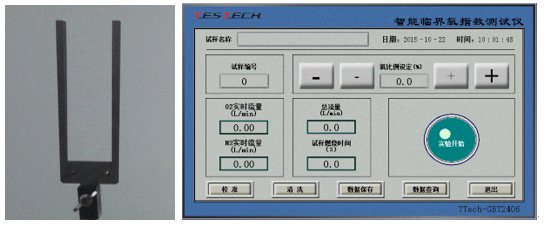
Figure 1: Fixture / Figure 2: Limiting Oxygen Index Interface
Figure 3: Limiting Oxygen Index Tester
Article Source — Bao Lüte Newsletter, Issue No.: 202206001CN
Featured Links:
